
Nature Communications Study Reveals Angiotensin-II-Driven Mechanism for Exacerbated Intracerebral Hemorrhage
Cloud-Clone ELISA kits and monoclonal antibody deliver critical tools for unraveling receptor-independent coagulation
Press Release Disclaimer: This is a press release distributed through the XPR Media network. It has not been independently verified by our newsroom.

Cloud-Clone ELISA kits and monoclonal antibody deliver critical tools for unraveling receptor-independent coagulation dysregulation
HUSTON, TX, UNITED STATES, October 26, 2026 /EINPresswire.com/ — Hypertensive intracerebral hemorrhage (ICH) carries high mortality and disability risks. Researchers have long observed a puzzling “thrombosis-hemorrhage paradox”: activated renin-angiotensin-aldosterone-system (RAAS) and elevated angiotensin-II (Ang II) can both promote vascular injury-related thrombosis and worsen bleeding under certain conditions. Conventional understanding attributes Ang II-linked ICH mainly to AT-receptor-mediated vasoconstriction and blood-pressure elevation. A new Nature Communications publication discloses a previously-unknown receptor-independent mechanism: Ang II directly binds antithrombin (AT) and triggers heparin-like allosteric activation, disturbing coagulation homeostasis and amplifying cerebral hemorrhage damage. Cloud-Clone ELISA kits and monoclonal antibody reagents supported key biomarker quantification and in-vivo neutralization within this multi-layered study spanning biochemical assays and hypertensive mouse disease models.
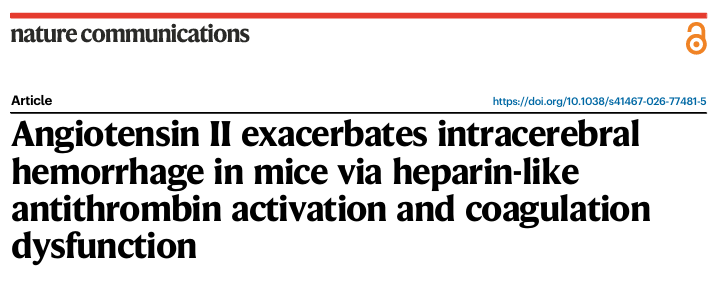
Figure 1: Screenshot of the original Nature Communications research-article webpage: Angiotensin II exacerbates intracerebral hemorrhage in mice via heparin-like antithrombin activation and coagulation dysfunction.
The unresolved thrombosis-hemorrhage paradox in hypertension-related ICH
Intracerebral hemorrhage represents the most devastating subtype of stroke. Hypertension ranks as its top risk factor, damaging small cerebral arteries and triggering vessel rupture. Canonical RAAS biology describes Ang II acting via AT1 receptors to constrict blood vessels, stimulate smooth-muscle proliferation and fuel inflammation.
Nevertheless, clinical and animal observations present a contradictory puzzle. When RAAS is persistently activated, higher Ang II levels encourage vascular damage and platelet activation that favour thrombus formation, while simultaneously increasing bleeding susceptibility. This inconsistency cannot be fully explained by blood-pressure-driven vessel injury alone.
Antithrombin (AT) is the primary physiological anticoagulant in circulation. Its baseline activity remains low until glycosaminoglycans such as heparin induce conformational shifts that potentiate AT inhibition against thrombin and factor Xa. Until this work, only polysaccharide molecules were known to exert such heparin-like effects. The research team hypothesized that polypeptide Ang II could directly interact with AT, trigger heparin-like anticoagulant activity, disrupt hemostasis and expand hematoma volumes following cerebral vessel rupture. Validating this idea demanded robust detection reagents for biochemical measurement, protein-protein interaction testing and in-vivo animal intervention.
Core innovations of the published study
This research moves past classic AT-receptor-dependent RAAS frameworks and delivers five major findings:
1.Polypeptide Ang II exerts heparin-like anticoagulant activity: Prior reports only credited polysaccharides with AT-activating heparin-like effects. This study demonstrates that peptide hormone Ang II directly binds antithrombin and induces functional conformational change to strengthen thrombin suppression.
2.Receptor-independent action: Enhanced AT activation persists within receptor-free recombinant-protein experimental systems, proving this Ang II function operates separately from well-characterized AT1 / AT2 signalling.
3.Defined molecular binding interface: Using site-directed mutagenesis and molecular docking, investigators mapped critical amino-acid residues mediating Ang II-AT contact. These structural insights support future rational drug-molecule design.
4.In-vivo pathological validation: Experiments using collagenase-induced ICH and 2K1C renovascular hypertensive mouse models confirm this signalling axis aggravates brain haemorrhage. Neutralizing circulating Ang II reduces hematoma size and restores normal coagulation profiles.
5.Closed-loop multi-technique evidence chain: Combining ELISA-based biomarker quantification, co-immunoprecipitation for protein-interaction verification and antibody-mediated in-vivo neutralization, the study achieves robust cross-validation and minimises off-target confounders.
Key experimental outcomes
In-vitro biochemical assays
Surface plasmon resonance confirmed direct Ang II-AT binding (KD = 14.1 µM). Mutagenesis identified AT residue R184 as essential for this interaction. After Ang II treatment, thrombin-driven fibrinopeptide-A (FPA) generation dropped markedly, whereas thrombin-antithrombin (TAT) complex abundance rose. Cloud-Clone CEB237Hu and SEA831Hu ELISA kits measured these two critical readouts.
Protein-protein interaction under physiological plasma conditions
With Cloud-Clone MAA005Mi21 anti-Ang II monoclonal antibody for co-immunoprecipitation, researchers captured endogenous Ang II from plasma samples and verified physical Ang II-AT complex formation under physiological conditions, ruling out experimental artefacts exclusive to purified recombinant-protein systems.
In-vivo animal intervention
In ICH-model mice, intravenous delivery of Cloud-Clone MAA005Mi21 anti-Ang II neutralizing antibody shortened bleeding duration, recovered coagulation competence and diminished hematoma volume and secondary brain tissue injury. In the 2K1C hypertensive mouse model, Cloud-Clone CEA005Hu Ang II ELISA kit confirmed elevated circulating Ang II levels in hypertensive animals. Collectively the animal-model data illustrate that excess Ang II activates AT, suppresses local thrombin function at rupture sites, impairs haemostasis and enlarges intracerebral hematomas. Blocking endogenous Ang II reverses this pathological anticoagulant shift.
Figure 2: Molecular-interaction diagram showing Ang II binding to antithrombin and critical amino-acid sites mediating allosteric AT activation.
Figure 3: Schematic workflow of 2K1C hypertension induction, ICH surgery, Ang II-neutralizing-antibody administration and downstream experimental readouts in C57BL/6J mice.
Figure 4: Conceptual overview illustrating how elevated Ang II triggers antithrombin-driven anticoagulation and amplifies intracerebral-hemorrhage progression under hypertensive vascular-injury conditions.
Cloud-Clone reagents supporting the full study workflow
Four Cloud-Clone products underpinned experiments ranging from in-vitro biochemistry to in-vivo animal intervention:
1.CEB237Hu (Fibrinopeptide A ELISA kit, competitive-binding format) Quantifies FPA released upon thrombin cleavage of fibrinogen, readout for thrombin catalytic activity; compatible with cell-culture supernatant, plasma and reaction-mixture samples.
2.SEA831Hu (Thrombin-Antithrombin complex (TAT) ELISA kit, sandwich format) Specifically detects assembled TAT complexes rather than isolated thrombin or AT protein, enabling assessment of AT activation status for thrombosis- and anticoagulation-focused work.
3.MAA005Mi21 (Anti-Ang II monoclonal antibody, clone D4, mouse IgG1 Kappa) Dual-purpose reagent: enables co-IP capture of endogenous Ang II for interaction studies, plus intravenous in-vivo neutralization in mouse models. Cross-reacts with human, mouse and rat Ang II, compatible with co-IP, western blot, IHC and systemic animal administration.
4.CEA005Hu (Angiotensin II ELISA kit, competitive-binding format) Measures circulating Ang II peptide concentration to validate 2K1C hypertensive-model establishment, suited for plasma, tissue homogenate and cell-culture supernatant specimens.
This combined reagent portfolio enables end-to-end investigation: Ang II hormone quantification, protein-interaction validation, thrombin-function evaluation, TAT-complex measurement and in-vivo neutralization intervention.
Research significance and translational outlook
This publication resolves the long-standing “thrombosis-hemorrhage paradox” within hypertension research. Beyond vasoconstrictive receptor-mediated effects, Ang II peptide itself can modulate coagulation homeostasis. Targeting the Ang II-AT protein-protein interface — instead of merely lowering systemic blood pressure — represents a prospective therapeutic strategy for hypertensive ICH.
Limitations remain. Most datasets derive from in-vitro biochemistry and pre-clinical animal models. Further clinical-sample investigation is required to define the real-world contribution of this pathway within human ICH patients. Future drug-development work may seek small-molecule or peptide inhibitors that selectively disrupt Ang II-AT binding while preserving essential physiological blood-pressure-regulating Ang II signalling.
Hypertensive intracerebral hemorrhage imposes heavy global public-health burdens. This Nature Communications work exposes a non-canonical RAAS-coagulation crosstalk mechanism that partially explains why hypertension worsens bleeding after cerebral vessel rupture. Rigorous, reproducible reagent performance is indispensable for high-impact translational discovery. Cloud-Clone provides validated ELISA assays and functional antibodies supporting cardiovascular, stroke, thrombosis and RAAS-focused mechanistic research for laboratories worldwide.
Reference: Jori C, Rehman AS, Ali A, et al. Angiotensin II exacerbates intracerebral hemorrhage in mice via heparin-like antithrombin activation and coagulation dysfunction. Nat Commun. DOI:10.1038/s41467-026-77481-5
SuKi Duan
CLOUD-CLONE CORP.WUHAN
Visit us on social media:
LinkedIn
Instagram
TikTok
X
Legal Disclaimer:
EIN Presswire provides this news content “as is” without warranty of any kind. We do not accept any responsibility or liability
for the accuracy, content, images, videos, licenses, completeness, legality, or reliability of the information contained in this
article. If you have any complaints or copyright issues related to this article, kindly contact the author above.

Media gallery
