Magnetic Beads Market to Reach USD 11.23 Billion by 2035 at 13.8% CAGR
Magnetic beads market growth is driven by automated diagnostics, nucleic acid purification, cell therapy, and
Press Release Disclaimer: This is a press release distributed through the XPR Media network. It has not been independently verified by our newsroom.
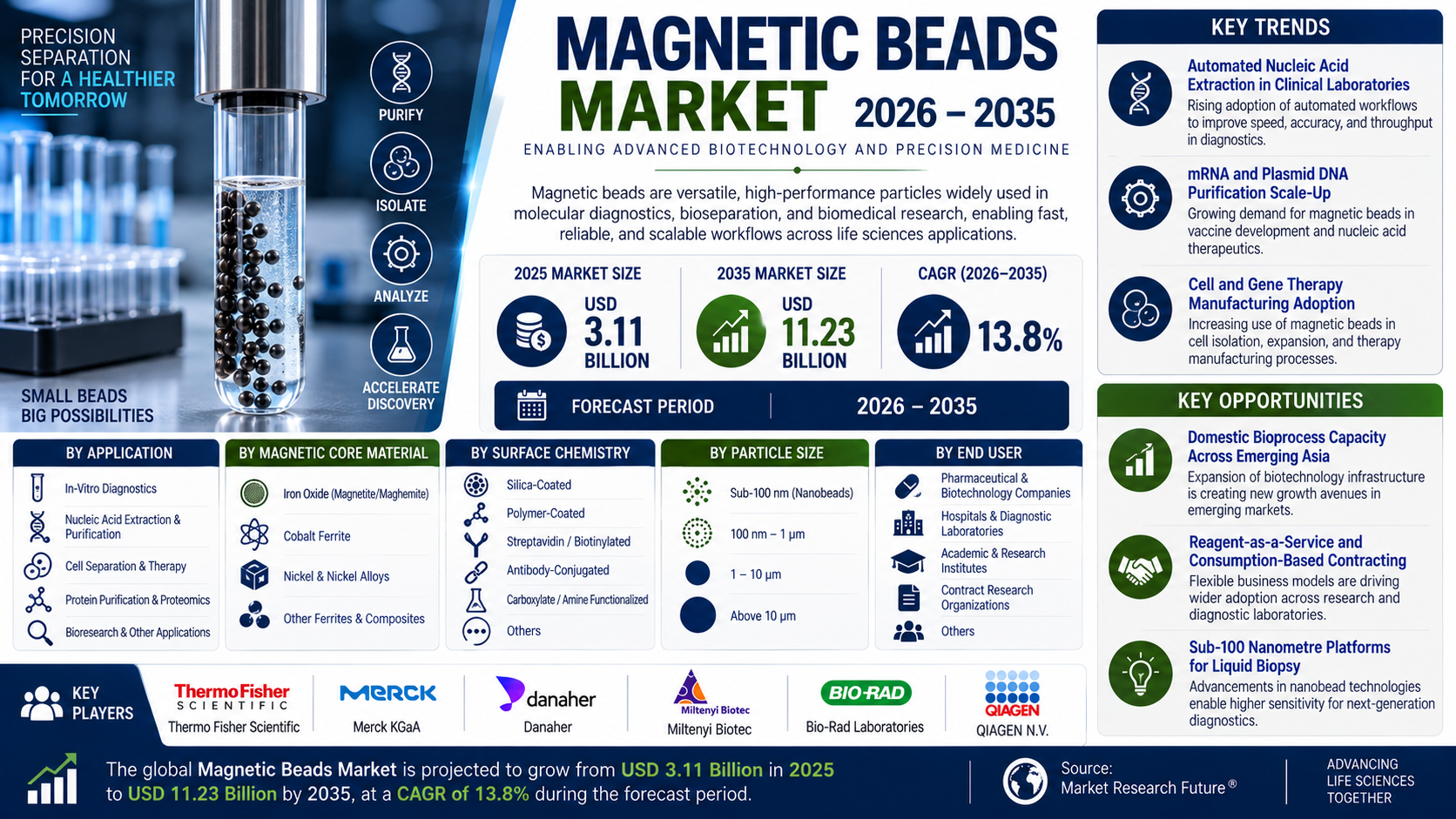

Magnetic beads market growth is driven by automated diagnostics, nucleic acid purification, cell therapy, and bioprocessing demand.
NY, UNITED STATES, September 17, 2026 /EINPresswire.com/ — The global magnetic beads market was valued at USD 3.11 Billion in 2025 and is projected to reach USD 11.23 Billion by 2035, registering a CAGR of 13.8% during the 2026–2035 forecast period, according to Market Research Future®. Growth is being supported by automated laboratory workflows, molecular diagnostics, nucleic acid purification, cell and gene therapy manufacturing, protein research and broader adoption of magnetic separation technologies.
Magnetic beads are functionalized particles designed to capture, isolate, separate or purify biological targets through magnetic forces. Their applications span in-vitro diagnostics, nucleic acid extraction and purification, cell separation and therapy, protein purification, proteomics, bioresearch and other life-science workflows.
Get Sample Report PDF| https://www.marketresearchfuture.com/sample_request/11767
Automated Molecular Workflows Drive Market Expansion
Laboratories are increasingly adopting automated sample-processing systems to improve workflow consistency, reduce manual handling and increase throughput. Magnetic beads are particularly suited to automated platforms because target molecules or cells can be captured and separated through controlled magnetic manipulation.
Clinical laboratories are expanding automated nucleic acid extraction capabilities as molecular testing becomes more integrated into diagnostic workflows. Magnetic bead-based extraction can support scalable processing of biological samples while fitting into automated laboratory instruments.
The wider molecular diagnostics market is therefore closely connected with magnetic bead adoption, particularly where laboratories require reproducible sample preparation before downstream testing.
Nucleic Acid Extraction Remains a Major Application
Magnetic beads are widely used to isolate DNA and RNA from biological samples. Surface chemistries can be engineered to selectively bind nucleic acids, allowing unwanted components to be removed during washing and the purified material to be recovered for downstream analysis.
Demand for nucleic acid extraction technologies is increasing alongside molecular testing, genomics research and biotechnology workflows. Automated purification platforms can also support higher-throughput processing in clinical and research environments.
The trend toward mRNA and plasmid DNA purification scale-up is creating additional demand for bead technologies capable of supporting larger bioprocessing volumes and increasingly sophisticated purification workflows.
Cell and Gene Therapy Adoption Creates New Demand
Cell and gene therapy manufacturing is another important growth area for magnetic beads. Cell separation and enrichment technologies can help researchers and manufacturers isolate specific cell populations during development and production processes.
Magnetic bead systems can be functionalized with antibodies or other binding molecules to selectively capture target cells. This makes cell separation relevant to research workflows as well as emerging therapeutic manufacturing applications.
As cell and gene therapy production becomes more industrialized, suppliers have opportunities to develop beads with improved selectivity, scalability and compatibility with closed or automated manufacturing systems.
Protein Purification and Proteomics Expand the Application Base
Magnetic beads are also used in protein purification and proteomics workflows. Functionalized surfaces can selectively capture proteins, antibodies and other biological targets, supporting purification and analytical processes.
The protein purification market provides a related area of opportunity because pharmaceutical and biotechnology companies require reliable methods for isolating biological molecules during research, development and manufacturing.
Magnetic bead technologies can offer operational flexibility compared with conventional separation approaches, particularly in workflows where automation, small sample volumes or parallel processing are important.
Iron Oxide Cores Remain Central to Magnetic Performance
By magnetic core material, the market is segmented into Iron Oxide (Magnetite/Maghemite), Cobalt Ferrite, Nickel & Nickel Alloys, and Other Ferrites & Composites.
Iron oxide materials are widely used because their magnetic properties can support efficient manipulation of particles in biological workflows. Magnetite and maghemite can be incorporated into bead structures and combined with surface coatings designed for specific applications.
Cobalt ferrite, nickel-based materials and other ferrites and composites provide additional options where different magnetic, chemical or performance characteristics are required.
Surface Chemistry Determines Targeting and Separation
Surface chemistry is an important differentiator because it determines how magnetic beads interact with biological targets.
The market includes Silica-Coated, Polymer-Coated, Streptavidin / Biotinylated, Antibody-Conjugated, Carboxylate / Amine Functionalized and other surface chemistries.
Silica-coated beads are particularly relevant to nucleic acid workflows, while antibody-conjugated and streptavidin/biotinylated surfaces can support selective capture of proteins, cells and other biological targets.
Carboxylate and amine functionalization provides additional opportunities for attaching molecules to bead surfaces and tailoring them for specific research, diagnostic and bioprocessing requirements.
Particle Engineering Opens Nanotechnology Opportunities
Particle size influences magnetic response, surface area, suspension behavior and interaction with biological targets.
The market is segmented into Sub-100 nm (Nanobeads), 100 nm–1 µm, 1–10 µm and Above 10 µm particles.
Sub-100 nm platforms represent an emerging opportunity for applications requiring high surface-area-to-volume characteristics. Their potential use in liquid biopsy workflows could support more sensitive approaches to capturing circulating biological targets.
Larger particles can provide different handling and separation characteristics, making particle-size selection dependent on the intended assay, target molecule, sample type and processing system.
Pharmaceutical and Biotechnology Companies Remain Key End Users
Pharmaceutical and biotechnology companies use magnetic beads across discovery, molecular biology, purification and bioprocessing workflows.
The growing adoption of biologics, cell therapies and nucleic-acid-based technologies is increasing the need for specialized laboratory consumables. Magnetic beads can become part of integrated workflows spanning research through process development and manufacturing.
For suppliers, this creates opportunities to develop application-specific products that address reproducibility, scalability, automation and regulatory requirements.
Clinical Laboratories Accelerate Automation
Hospitals and diagnostic laboratories represent another important end-user group. Automated sample preparation can reduce repetitive manual procedures and support standardized molecular testing workflows.
The increasing use of automated nucleic acid extraction in clinical laboratories is encouraging demand for bead-based reagents compatible with diagnostic instruments.
Reagent consistency is particularly important in clinical workflows because bead performance can influence extraction efficiency, downstream assay compatibility and overall laboratory throughput.
Emerging Asia Offers Bioprocessing Opportunities
The expansion of domestic bioprocess capacity across emerging Asian markets is creating opportunities for magnetic bead suppliers.
Growing pharmaceutical manufacturing, biotechnology research and laboratory infrastructure can increase demand for locally available consumables and process technologies. Domestic production initiatives may also encourage regional supply-chain development for critical bioprocessing materials.
For manufacturers, emerging markets can provide opportunities through local partnerships, technical support, application development and consumption-based supply models.
Reagent-as-a-Service Creates a New Commercial Model
Reagent-as-a-service and consumption-based contracting represent an emerging commercial opportunity in the magnetic beads industry.
Rather than purchasing laboratory consumables solely through traditional product transactions, customers can increasingly evaluate models based on recurring usage, workflow requirements or processing volumes.
Such models may be particularly relevant to high-throughput laboratories and biotechnology companies seeking predictable access to specialized reagents while managing inventory and procurement requirements.
Advanced Beads Support Bioprocess Scale-Up
The scale-up of mRNA and plasmid DNA purification is creating demand for magnetic beads capable of meeting increasingly demanding processing requirements.
Manufacturers can differentiate through bead consistency, binding capacity, surface chemistry, magnetic response and compatibility with automated equipment.
The ability to move from research-scale workflows toward larger production environments can become increasingly important as pharmaceutical and biotechnology companies expand advanced therapeutic pipelines.
Liquid Biopsy Represents an Emerging Application
Sub-100 nanometre magnetic bead platforms provide an emerging opportunity in liquid biopsy applications.
Liquid biopsy workflows can involve the detection or enrichment of biological material from blood and other samples. Magnetic separation can potentially support target enrichment before downstream molecular analysis.
Advances in bead surface functionalization and particle engineering may expand their usefulness in applications requiring selective capture of low-abundance biological targets.
Competitive Landscape
The magnetic beads market includes global life-science companies and specialized biotechnology suppliers competing across magnetic core materials, surface chemistries, particle sizes and application-specific solutions.
Key players include Thermo Fisher Scientific, Merck KGaA, Danaher, Miltenyi Biotec, Bio-Rad Laboratories and QIAGEN N.V.
Competition is influenced by reagent performance, product consistency, automation compatibility, application expertise, manufacturing scale and relationships with pharmaceutical, biotechnology, diagnostic and research customers.
Companies are also positioned to benefit from growing demand for automated workflows, advanced purification technologies and specialized beads for cell and gene therapy applications.
Outlook Through 2035
The magnetic beads market is expected to maintain strong expansion through 2035 as molecular diagnostics, biotechnology research, advanced therapeutics and bioprocessing continue to increase demand for efficient separation and purification technologies.
Automated nucleic acid extraction will remain an important application, while mRNA and plasmid DNA purification scale-up can create opportunities for higher-performance bead systems.
Cell and gene therapy manufacturing is also expected to broaden the application base, particularly for selective cell separation and enrichment workflows.
At the same time, emerging opportunities in domestic Asian bioprocess capacity, reagent-as-a-service models and sub-100 nanometre platforms for liquid biopsy can create additional avenues for product and business-model innovation.
The combination of automation, advanced surface chemistry, particle engineering and expanding life-science applications will remain central to the market’s development through 2035.
Read the full Magnetic Beads Market Research Report:
https://www.marketresearchfuture.com/reports/magnetic-beads-market-11767
Forecast Period: 2026–2035
2025 Market Size: USD 3.11 Billion
2035 Market Size: USD 11.23 Billion
CAGR: 13.8%
Related Insights
Us Polymer Dispersion Market https://www.marketresearchfuture.com/reports/us-polymer-dispersion-market-12755
India Pre-Engineered Buildings Market https://www.marketresearchfuture.com/reports/india-pre-engineered-buildings-market-2565
Logistics Market https://www.marketresearchfuture.com/reports/logistics-market-5076
India Commercial Real Estate Market https://www.marketresearchfuture.com/reports/india-commercial-real-estate-market-20709
Air Cargo Market https://www.marketresearchfuture.com/reports/air-cargo-market-8271
Market Research Future
Market Research Future
+1 855-661-4441
email us here
Legal Disclaimer:
EIN Presswire provides this news content “as is” without warranty of any kind. We do not accept any responsibility or liability
for the accuracy, content, images, videos, licenses, completeness, legality, or reliability of the information contained in this
article. If you have any complaints or copyright issues related to this article, kindly contact the author above.

Media gallery